mirage
true-multichannel transparent reverb
coming soon
to hear when it is out, write to info@echotope.com.
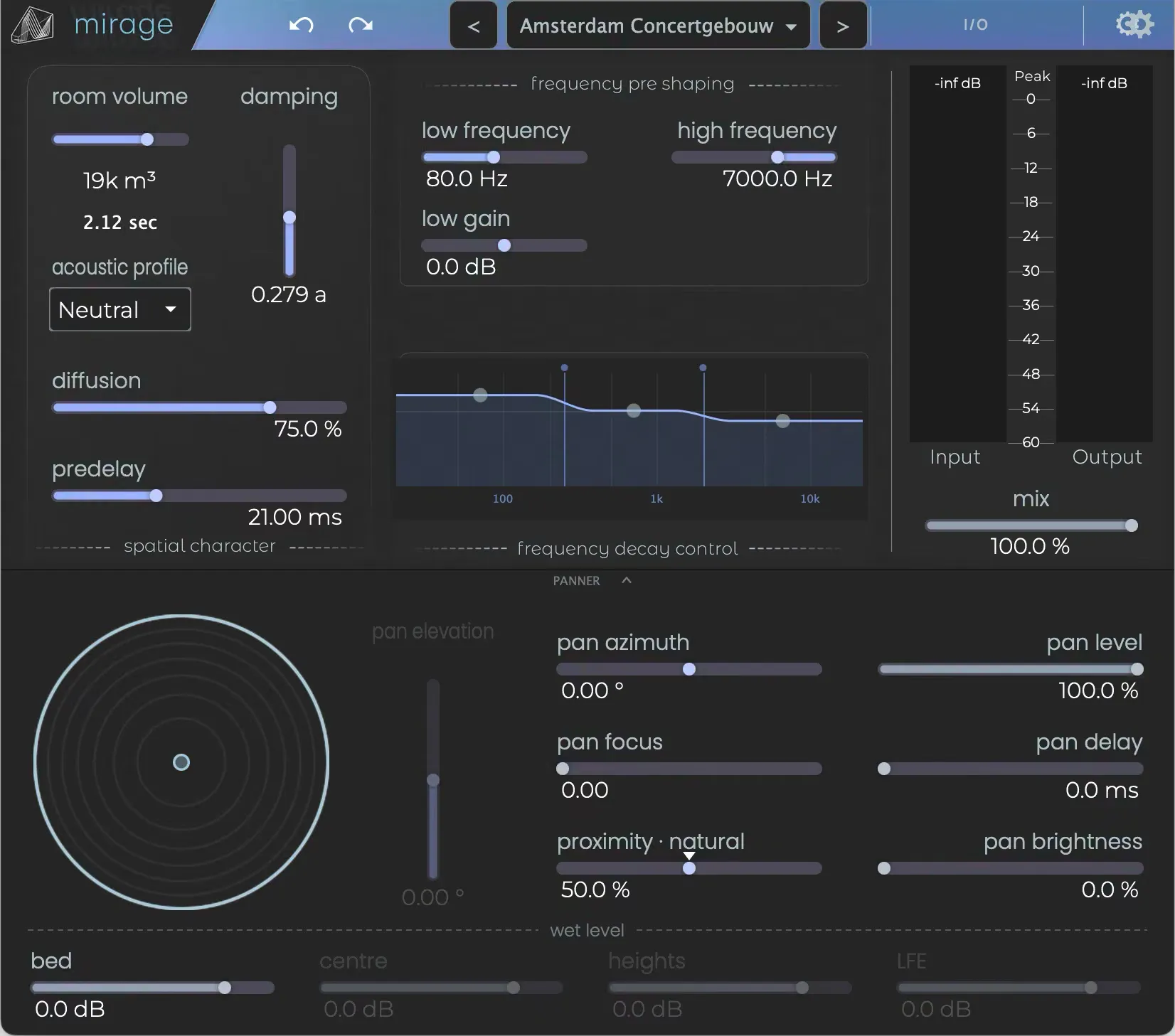
Mirage models the resonances of a room rather than its reflections. It focuses on the late reverberant field, where echoes dissolve into the resonance of the space. As in a real room, the volume you set determines how densely those resonances are packed. Your source keeps its own tone; the space seems to emerge from the sound itself.
The sound of each source is captured by each virtual microphone (ie. outputs) in the created acoustic space, from stereo up to 9.1.6. Shape it like an acoustician: room volume, damping, diffusion, and predelay. Grounded in room acoustics and tuned by ear to make the illusion hold: a mirage the ear believes.
- multi-input / multi-output algorithmic reverb
- true stereo and spatial up to 9.1.6
- smooth, realtime adjustable parameters
- run many instances at once with minimal cpu usage
formats: .vst3, .au, .aax
stereo, immersive up to 9.1.6
the room
- room volume sets the size of the space. the reverberation time follows from volume and damping, and is shown next to it.
- damping is set as an absorption coefficient.
- diffusion and predelay shape the density and the onset of the tail.
- acoustic profiles and room presets, for example amsterdam concertgebouw.
the tone
- frequency decay control shapes how long low, mid and high frequencies ring, with two movable crossover points.
- frequency pre-shaping: a low and a high cutoff and a low gain, applied before the reverb.
the space
- a built-in panner places the reverb output in the room: azimuth, elevation, level, focus, delay, brightness and proximity.
- wet level for each channel group: bed, centre, heights and lfe.
the workflow
- input and output meters, a mix control, undo and redo, and a preset browser.